Trajectory cognitive intelligence
Your operation forgets
itself every day.
RUV does not.
Deployed into a single operation, RUV learns how it actually behaves, keeps every detail, and seals the record so someone else can check it. Deterministic. Always on. No cost per query, so the margin does not erode with use.
Continuity
Nothing is discarded between one session and the next.
Determinism
The same inputs return the same output, every time.
No inference cost
Reasoning happens without a model call.
Together, these three make the output evidence, not opinion.
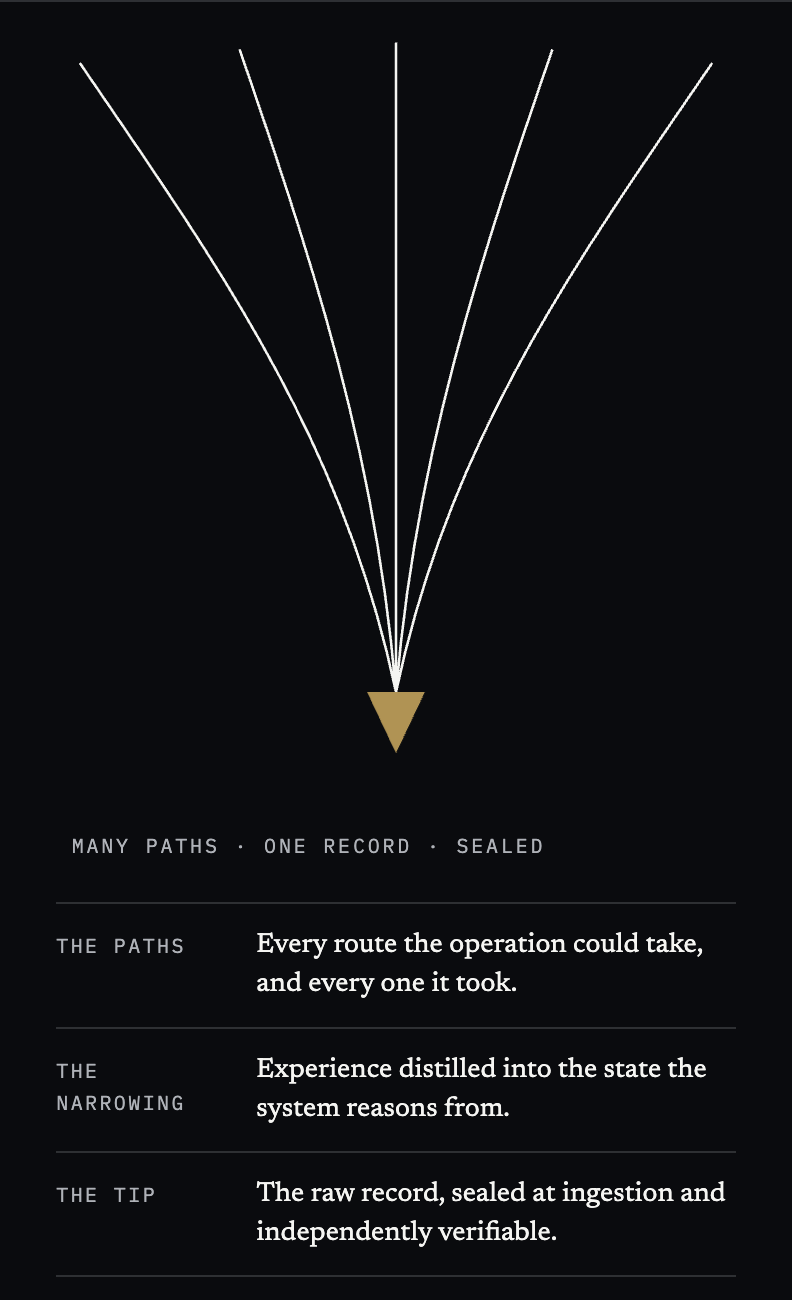
Many paths · one record · sealed
The paths
Every route the operation could take, and every one it took.
The narrowing
Experience distilled into the state the system reasons from.
The tip
The raw record, sealed at ingestion and independently verifiable.

01 · Problem, solution, benefit
Operations remember almost nothing
about themselves
The problem
The detail is generated, then discarded
An operation produces an enormous amount of detail every day and keeps almost none of it. Systems answer when asked and forget the moment they finish.
So an organisation cannot tell whether a reading is unusual for that asset. It can only tell whether the reading crossed a threshold set by someone who never saw the asset.
And when something does fail, the evidence of how it got there was never kept.
The solution
A system that stays inside the operation
RUV is deployed into a single operation and remains present in it. It learns how that operation actually behaves and retains every detail.
Reasoning runs from accumulated experience rather than a fresh prompt, deterministically, and without a model call.
The raw stream is sealed as it arrives, in a single archive, held separately from the state the system reasons with.
The benefit
Three things a buyer can act on
Change is measured against the asset's own history, not a generic threshold, so a departure is visible before it becomes a failure.
The record is evidence rather than assertion, so it holds in audit, insurance and regulation without further argument.
Value compounds. A system that has watched an operation for three years cannot be replicated by a competitor switching one on tomorrow.
02 · What it does
Seven capabilities, continuously
RUV is not an agent and not a domain tool. The engine works across any operation, and each deployment is configured with the domain knowledge it needs before it begins to learn. Seven capabilities run continuously, for as long as the operation runs.
Intelligent from day one
Deploys with domain knowledge already active. Physical constraints, safety limits, and operational rules are present before the first reading arrives. What is learned over time is the asset's specific behavioural identity.
Learns continuously, zero cost
Updates its understanding as events arrive, without per-event charges or retraining cycles. Watching an operation continuously costs the same as watching it occasionally.
Deterministic conclusions
Produces repeatable outputs. Any party can rerun a record and obtain the identical result. This is what makes the output evidence rather than opinion.
Trajectory detection
Detects departures based on behavioural contradiction and rate of change, not static thresholds. Trajectory detection fires before any threshold is crossed.
Structurally immune to poisoning
Operational events cannot overwrite taught knowledge. There is no write path from incoming readings to the deployed constraints, safety thresholds, or domain rules. Attempts to manipulate what the system accepts as normal fail structurally.
Error dampening
A single corrupted reading cannot permanently distort the system's understanding. Outliers and faults dampen rather than amplify, and the behavioural identity recovers as clean readings resume.
Human oversight
Every detection is surfaced to an operator for review. No automated action is taken. The operator sees what clashed, at what severity, with what evidence, and makes the decision. The decision is logged alongside the detection, creating an auditable record of both the conclusion and the human response. This is the architecture required for EU AI Act Article 14 compliance in high-risk applications.
All seven run without per-query cost, so watching an operation around the clock does not increase the bill. That is the difference between a system you can afford to leave switched on and one you cannot.
03 · Comparison
A language model and RUV are not
the same instrument
This is not a claim that one is better. They are built for different jobs, and the difference is architectural. A model that samples cannot be deterministic, and a model that charges per token cannot be left running.
| Large language model | RUV | |
|---|---|---|
| Memory | A context window. Bounded, and discarded when the session ends. | Retained state. Nothing is discarded between sessions. |
| Same question, twice | Sampled. Two runs can return two different answers. | Deterministic. The same inputs return the same output, every time. |
| Cost model | Per token. Cost scales with how often you ask. | No per-query cost. Reasoning happens without a model call. |
| Continuous operation | Economically bounded. Watching around the clock is priced out. | Designed to stay switched on. Volume does not change the bill. |
| Provenance | Output is generated. There is nothing to seal and nothing to rerun. | Sealed at ingestion, and independently verifiable by a third party. |
| Where it is strong | Language, generation, breadth of general knowledge, reasoning across unfamiliar ground. | Depth in one operation, continuity over years, and a record that stands up to audit. |
RUV does not replace a language model, and it is not trying to. It does the job a language model is structurally unable to do: stay present inside one operation, remember all of it, and produce a record someone else can check.
04 · Defensibility
What a larger model cannot copy
The obvious question is whether a longer context window closes the gap. It does not, because the properties below are architectural rather than a matter of scale.
Determinism
Hover to learn more
The same inputs always return the same output. Any third party can rerun a record and obtain the identical result, which is what makes it evidence rather than opinion.
A sampled model cannot offer this. Ask it twice and it answers twice.
No per-query cost
Hover to learn more
Reasoning happens without a model call, so cost does not scale with use. Watching an operation every second of every day costs the same as watching it occasionally.
A model that charges per token cannot be left running continuously.
Adversarial resistance
Hover to learn more
The taught knowledge base cannot be altered by operational events. There is no write path from an incoming reading to the physical constraints, safety thresholds, or domain rules the system was deployed with.
An operation that attempts to gradually train the system to accept abnormal behaviour as normal will find that the taught model does not move. This is a structural property of the architecture, not a policy control.
Error dampening
Hover to learn more
A single corrupted reading, whether from a sensor fault, a network anomaly, or a deliberate injection, cannot permanently alter the system's understanding. Error propagates with a ratio below 1.0, meaning it dampens rather than amplifies.
One clean reading after an extreme outlier restores the identity model to within 0.1% of its prior state. Tested at corruption levels from 0.1% to 10%. At all levels, the error shrank.
None of these properties is a matter of scale.
Determinism, zero per-query cost, adversarial resistance, and error dampening are architectural. No context window closes that gap, and no amount of compute buys it.
05 · Applications
Where a continuous record
is worth paying for
The engine is domain agnostic, so the question is not whether it fits a sector but whether that sector has an operation worth remembering and a record someone else needs to trust. Six that do.
These describe where the architecture applies. They are not delivered engagements. Named deployments will appear here when they exist, each with a verification link rather than a claim.
Built environment
Industrial process plant
Energy networks
Cold chain and logistics
Regulated manufacturing
Critical facilities
The pattern is the same in all six. The operation runs continuously, the useful signal is a change against its own history rather than against a threshold, and somebody outside the organisation eventually asks to see the evidence.
Does your operation qualify?
It runs continuously, the useful signal is a change against its own history rather than a threshold, and somebody outside eventually asks to see the evidence. If all three are true, it fits.
06 · Synthetic case study
What changes when the record exists
This is a synthetic illustration, not a delivered engagement. It describes what a deployment would look like in a built environment operation, based on the architecture as it exists today. Named case studies will appear here when they are earned.
Scenario: commercial building portfolio, 12 assets
Before · without RUV
HVAC anomalies detected by threshold alarms. Average lead time: two to four hours before failure.
Post-incident evidence assembled manually from whatever survived. Gaps filled with reconstruction.
GRESB submission relies on quarterly summaries prepared by the facilities team. Auditor queries take weeks to resolve.
Asset condition at sale is asserted by the operator. Buyer discounts accordingly.
Insurance renewal based on claims history and generic risk models. No operational evidence submitted.
After · with RUV
Departures detected against each asset's own behavioural history. Lead time measured in days or weeks, not hours.
Evidence already exists, sealed before anyone knew it would matter. Checked rather than argued.
GRESB data drawn directly from the verified archive. Auditor traces any figure to its sealed source record in minutes.
Condition history is verifiable by the buyer directly. An asset with a provable record commands a different price.
Insurer receives a continuous, sealed operational record. Risk is priced on evidence rather than estimation.
Detection lead time
Hours
Days to weeks
Post-incident evidence
Reconstructed
Already sealed
Audit response time
Weeks
Minutes
Asset valuation basis
Assertion
Verified record
The shift is not dramatic on day one. It is dramatic on year one, when the record exists and the question is no longer whether the operation behaved well but whether anyone can prove it did.
This scenario is illustrative. Specific metrics (lead time improvement, audit time reduction) will be measured and published from the first live deployment. No figure is claimed until it is observed.
07 · Verification
Experience only counts
if it can be verified
An accumulated record is an asset only where a third party can confirm it has not been altered. Every state RUV records resolves to a public page that anyone can open, with no account and no request to us.
How a record is sealed
Hash at ingestion
SHA-256 content hash computed the moment data arrives, before any downstream process can touch it.
KMS signature
RSA-4096 digital signature applied via AWS KMS using a non-exportable key. Timestamp locked.
Chain link
Record appended to a hash chain. Each entry references the previous, making silent removal detectable.
Sealed
At the moment of ingestion, before anything downstream can touch it.
Open
Verifiable without an account, without contacting the issuer.
Detectable
Amendment is detectable rather than deniable.
Independent
Confirmable without trusting the party presenting the record.
Check a record yourself. The verification page opens without an account and without contacting us. Nothing on it depends on trusting the party that produced it.
For technical evaluators
08 · Architecture
Two layers, and the separation
is the point
An operation takes a different route every day, and almost all of it is normally lost. RUV holds two things instead, in two places, for two different reasons.
Layer one · the core
Distilled cognitive state
Experience compressed into the state the system reasons from. The core is fast because it is small, and it is small because it is not a store. It does not hold the raw stream.
- Reasoned from directly
- No model call, no per-query cost
- Deterministic under replay
Layer two · the evidence layer
The raw event archive
Exact values, precise timestamps, individual observation records. Retained in exactly one place, sealed at the moment of ingestion, and never rewritten.
This layer is the tip of the mark.
- Audit
- Recovery
- Valuation
Distilled state is what makes it fast. The archive is what makes it evidence. Separating them is why it can be both.
09 · The destination
An operation that finally
remembers itself
Nothing about the first week is dramatic. The point of RUV is what the operation becomes after it has been running for years, and what stops being an argument once it has.
Week one
Configured
Domain knowledge is loaded at deployment. Physical constraints, safety thresholds, and operational rules for this domain are active before the first reading arrives. What is not yet built is the asset's specific behavioural identity. That is what the first weeks of data produce. Sealing begins immediately.
Month three
Baseline
The system knows what normal looks like for this operation, asset by asset, rather than against a threshold written by someone who never saw it. Departures start surfacing with the context that explains them.
Year one
Evidence
A full annual cycle is held, including the seasonal behaviour no threshold captures. The record is now something that can be handed to an auditor, an insurer or a regulator without preparation.
Year three
Asset
The archive is worth more than the software that produced it. Replacing RUV no longer means changing supplier. It means starting the record again at zero.
What changes, and for whom
Three people experience it differently, and all three are in the room when the decision is made. Hover each card to see the shift.
The operations lead
Today: an alarm fires, and the question is whether the reading is bad. Nobody can say whether it is unusual for that particular asset, because nobody kept the history.
Hover to see the shift
The operations lead
With RUV: the alert arrives with the asset's own history attached, and the question becomes what changed and when it started.
The risk and assurance lead
Today: after an incident, evidence is assembled from whatever survived. Gaps are filled with reconstruction, and reconstruction is arguable.
Hover to see the shift
The risk and assurance lead
With RUV: the record already exists, sealed before anyone knew it would matter, and it is checked rather than argued.
The owner or investor
Today: the condition of the asset is asserted by whoever operated it, and a buyer discounts accordingly.
Hover to see the shift
The owner or investor
With RUV: condition history is verifiable by the buyer directly. An asset with a provable record is not the same asset as one without.
The shift is from threshold to trajectory, and from assertion to evidence.
Both are small changes in wording and large ones in consequence. A threshold tells you a limit was crossed. A trajectory tells you when the crossing became inevitable, which is the only version of the information anyone can act on.
An assertion has to be believed. Evidence has to be checked. Every organisation that has ever lost an argument with an insurer, a regulator or an acquirer understands the difference in price between the two.
This is the destination the architecture is built to reach. The first deployment is where it begins to be measured.
10 · Value
Value compounds with time
in the operation
A conventional system performs at roughly the same level in month twelve as in month one. RUV is designed so that capability grows with the experience it has accumulated, and the verified record grows in parallel with it.
Value accumulation over time
Capability grows with experience (conceptual illustration)
Conceptual illustration of the compounding mechanism. Not a forecast.
11 · Market and value
The market has stopped paying for capability
and started paying for proof
Three figures describe the moment RUV is entering. The first is why capital is available. The second and third are why most of it will be withheld from anything that cannot be checked.
$2.59tn
Worldwide AI spending, 2026
Up 47 per cent year on year, with infrastructure taking more than 45 per cent of it. Gartner calls 2026 the inflection year.
The budget exists.
Gartner, 19 May 2026
22%
Have tied AI spend to outcomes
Close to ninety per cent of finance leaders report pressure to link AI spending to business outcomes. Twenty-two per cent have managed it.
The budget is conditional.
Cloudzero, 2026 · Gartner
23%
Of revenue lost to inference
At scaling-stage AI companies, inference averages twenty-three per cent of total revenue. AI-native margins sit at 50 to 60 per cent against 70 to 90 for mature software.
The budget is expensive to serve.
ICONIQ, January 2026 · Bessemer
AI market breakdown
2026 spending distribution
Key industry metrics
Percentage indicators across AI sector
Of all AI spending goes to infrastructure rather than applications.
Gartner, May 2026
Of revenue is consumed by inference at scaling-stage AI companies.
ICONIQ, January 2026
Of finance leaders have tied AI spending to a business outcome.
Cloudzero, 2026
Of every venture pound in the first quarter went to AI companies.
Carta, Q1 2026
Of AI projects are not expected to survive to 2028.
Gartner
Of AI companies report gross margin erosion from infrastructure cost.
ICONIQ, January 2026
Sector by sector, the spend already exists
RUV does not need to create a category. It needs to be bought inside categories that are already funded, already procured through and already measured in billions.
Industrial plant and manufacturing
Predictive maintenance, roughly $14bn to $18bn in 2026, forecast to $80bn to $100bn by the early 2030s.
The category exists because thresholds fire late. RUV is bought where the question is not whether a limit was crossed but when the crossing became inevitable.
Energy and utilities
Asset performance management, estimated between $4bn and $29bn in 2026 depending on definition.
Regulated asset owners must evidence condition to a regulator. An assertion is challenged. A sealed record is checked.
Cold chain and logistics
Cold chain monitoring, roughly $8bn to $12bn in 2026, growing at 12 to 15 per cent annually.
The whole category is about custody and proof. Every excursion becomes a dispute, and a dispute is settled by whoever holds the better record.
Built environment
Served through the same asset performance budget, with sustainability and emissions management the fastest-growing solution line.
Condition and emissions reporting now sit in front of auditors and lenders. A verifiable history changes the asset's value, not only its running cost.
Financial services and RegTech
Regulatory technology, roughly $22bn in 2026, forecast to $38bn by 2030 and $85bn by 2035.
Compliance runs on evidence. A record sealed at ingestion and rerunnable by a supervisor is worth more than one assembled afterwards.
ESG reporting
ESG reporting software $1.1bn to $1.7bn in 2026. Wider ESG software $4.78bn.
Disclosure is moving from assertion to assurance under CSRD and ISSB. Audit-ready means a third party can check the underlying record, not the summary.
Carbon credits
Roughly $785bn to $1.11tn in 2026, forecast between $1.76tn and $10.5tn by the early 2030s.
The category's central problem is whether a credit represents what it claims. Measurement, reporting and verification is the bottleneck.
Blockchain and provenance
Blockchain overall $54bn in 2026, forecast to $611bn by 2031.
RUV seals records cryptographically without requiring a chain, a token or a consortium. It serves the demand this category was created to serve, without its adoption cost.
IoT and machine-to-machine
AI applied to connected devices, $25.4bn in 2025 rising to $81bn by 2030.
Devices generate the stream. Almost nobody keeps it, and nobody can prove what it said. RUV is the layer that retains and seals it.
$864bn
Estimated annual cost of unplanned downtime to global manufacturing, and the single figure that justifies every predictive maintenance budget in existence. Separately, unplanned downtime is put at around $125,000 per hour for the businesses it hits.
Sector analysis 2026 · ABB survey
How to read these numbers
Total addressable market is the wrong frame here, and quoting one would be the easiest thing on this page to disbelieve. Nine categories, each measured in billions, is context rather than entitlement. RUV will not be sold into all of them and does not need to be.
What the nine share is a single unmet requirement. Each one depends on a record of what actually happened, held over time, that somebody outside the organisation can check.
The addressable slice is priced per operation, not per seat and not per token. So the honest sizing question is how many qualifying operations exist inside these categories and what a continuous, sealed record is worth to each one.
Those are the two numbers the first deployments are designed to produce, and they will be published once they exist rather than modelled now.
12 · For investors
What is architectural, and what is
still being tested
We separate the two, because a claim that cannot be checked is worth less than an admission that can. Everything marked architectural is a property of how the system is built and is demonstrable on request.
| Property | Status | How it is checked |
|---|---|---|
| Continuity of experience | Architectural | Retained state persists across sessions, restarts and infrastructure changes. |
| Determinism | Architectural | Rerun any record and compare the output. It is identical or it is not. |
| No inference cost | Architectural | Reasoning executes without a model call. Cost is independent of query volume. |
| Sealed provenance | Architectural | Records seal at ingestion and resolve to a public verification page. |
| Knowledge base isolation | Architectural | No write path from operational events to taught knowledge. Tested: 50 fabricated readings injected, safety thresholds and physical constraints unchanged. |
| Error dampening | Architectural | Error propagation ratio consistently below 1.0. Tested at corruption levels from 0.1% to 10% of the event stream. At all levels, the error shrank rather than grew. |
| Early detection lead time | Under test | The value case rests on it. Quantifying it is the purpose of the first deployment, and no figure is claimed until it is measured. |
| Cross-domain transfer | Under test | The engine is domain agnostic by construction. The cost of configuring a new domain is being measured deployment by deployment. |
There are no customer logos on this page and no performance figures, because we have not yet earned the right to show either. When we do, they will be verifiable at the link rather than asserted on a slide.
Stage and ask
Stage
Pre-revenue. Architecture built, first deployment being scoped.
What the capital funds
First deployment, measured results, and the team to deliver both.
The investor pack contains the full underwriting: the architecture, the status of every claim, the commercial model, and what the first deployment is designed to measure. Request it below or at the contact form.
Gross margin comparison
Why no inference cost changes the economics
How this category is being valued in 2026
Analysts covering the sector report the same shift. The market is separating AI as a feature from AI as an economic engine, and defensibility now outweighs growth rate in most investor scoring frameworks.
| What is priced | Where the market sits | Where RUV sits structurally |
|---|---|---|
| Gross margin | Revenue partly subsidised by compute is treated cautiously. Companies with a credible path to 60 per cent and above are rewarded. | Reasoning runs without a model call, so there is no inference line to erode the margin. Cost does not rise with query volume. |
| Revenue quality | Contracted revenue tied to a specific workflow is valued more strongly than usage that is hard to forecast or easy to churn. | Sold per operation, contracted, and embedded in the operation it learns. Leaving means discarding the accumulated record. |
| Defensibility | Proprietary data assets drive multiples. IP-light companies face material markdowns against protected peers. | The archive is the asset and it appreciates. Three years of one operation cannot be bought, only accumulated. |
| Multiple context | Private AI-native software prices at roughly 15 to 30 times ARR, against 3 to 7 for legacy software. | Reference points only. RUV claims no valuation and will not until revenue exists to price. |
What the asset actually is
A conventional software company owns a product. RUV owns something closer to an instrument record: a sealed, continuous account of how a specific operation behaved, held for as long as that operation runs.
That record has three separate buyers. The operator, who uses it to run the asset. The assurer, who uses it to price risk. And the acquirer, who uses it to value the asset itself, because a building, a plant or a network with a verified condition history is not the same asset as one without.
The economics follow from the architecture rather than from a pricing decision. Continuity creates the switching cost. Determinism makes the output admissible. No inference cost means the margin does not degrade as the system is used more heavily, which is the exact failure mode the market is currently repricing.
The company is worth what the archive is worth, and the archive is only worth something because it can be verified.
Figures on this page are third-party market references, attributed and dated. They describe the market RUV is entering, not RUV's own performance. No valuation, revenue or customer figure is claimed anywhere on this site.
13 · Pricing
Priced per operation.
Not per seat. Not per token.
The cost model follows from the architecture. Because reasoning runs without a model call, usage does not change the bill. One operation, one price, regardless of how often you ask or how long it runs.
Per operation
Each deployment is priced as a single operation. The scope is defined before deployment begins, and the price does not change with query volume.
No inference cost
Watching an operation every second of every day costs the same as watching it occasionally. There is no token meter running in the background.
Contracted
Annual contract, tied to a specific operation. No usage surprises, no variable billing, no cost escalation as the system becomes more valuable.
The real question is what failure costs
Unplanned downtime costs global manufacturing an estimated $864 billion a year. For the businesses it hits, the figure is roughly $125,000 per hour offline. That is before the regulatory penalty, the insurance dispute, and the reputational damage that follows when a client, a regulator or a counterparty asks for evidence and none exists.
RUV is not priced against a software budget. It is priced against the cost of the incident that was not detected early enough, the audit that could not be answered, and the reputation that took years to build and one unverified record to lose.
The honest question is not what a continuous, sealed record costs. It is what happens when an insurer, a regulator or an acquirer asks to see one and it does not exist. Downtime is measurable. Reputational loss is not, and it compounds.
For a scoped estimate
Book a demo14 · Integration
How data enters the system
RUV sits alongside existing infrastructure. It does not replace anything, and it does not require a rearchitecture. The question is simply how the operational stream reaches the engine, and there are three ways.
Sensor buses
A lightweight service sits alongside existing infrastructure and reads from local sensor protocols: Modbus, serial, GPIO, HTTP. It forwards the operational stream to RUV over HTTPS. The collector does not control the operation. It observes.
API ingestion
A lightweight REST endpoint receives structured event data from any system that can make an HTTP call. JSON payloads, timestamped, authenticated with a deployment-specific key. Most integrations start here.
Python SDK
For developers and platform integrators, a Python SDK handles authentication, upload, and verification programmatically. Any system that can run Python can send data to RUV with three lines of code.
Compatible systems
The integration is scoped during the first conversation. Most operations already expose the data RUV needs. The deployment question is not whether the data exists but whether it is currently being kept.
For CTOs and operations leads
Discuss integration15 · Security and compliance
Where the data lives, who can
see it, and how it is protected
A system that produces evidence must itself be evidently secure. The architecture separates what the system reasons from and what it seals, and the security model reflects that separation.
Data residency
Deployment data remains within the region specified at contract. No cross-border transfer without explicit agreement. Current infrastructure supports UK, EU and Asia-Pacific residency.
Encryption
Data encrypted at rest using AES-256 and in transit using TLS 1.3. The sealed evidence archive uses three cryptographic layers: SHA-256 content hashing for tamper detection, RSA-4096 digital signatures via AWS KMS (non-exportable signing key) for independent proof of processing, and a hash chain linking each record to its predecessor for provable sequence integrity.
Access model
Role-based access with least privilege by default. The operator sees the cognitive state. The evidence archive is read-only and externally verifiable. No RUV employee accesses client operational data without explicit authorisation.
Separation of layers
The cognitive state (what the system reasons from) and the evidence archive (the sealed raw record) are held in separate AWS accounts with independent access boundaries. A compromise of the processing layer cannot access or modify the evidence layer, because they do not share credentials, IAM policies, or a trust boundary.
Immutability enforcement
The evidence archive operates in S3 Object Lock COMPLIANCE mode. Records cannot be deleted or modified within the retention period by any user, including administrators and the AWS account root user. This is enforced by AWS at the storage layer, not by access policy. GOVERNANCE mode allows privileged users to override the lock; COMPLIANCE mode does not. We use COMPLIANCE.
Audit trail
Every access to the evidence archive is logged. The seal itself is the audit trail for the data: any amendment is detectable by any party holding the original hash, without contacting RUV.
Target certifications
SOC 2 Type II and ISO 27001 are on the certification roadmap, timed to coincide with the first enterprise deployment. The architecture was designed with these frameworks in mind from the outset.
The strongest security property is architectural. Because the evidence archive is sealed at ingestion and independently verifiable, tampering is not prevented by policy alone. It is detectable by anyone holding the hash, whether or not they trust the party that produced the record.
For CISOs and technical evaluators
Request security documentation16 · Standards mapping
What your auditor asks, and
how RUV answers it
Assurance frameworks share a common requirement: evidence that is traceable, complete and independently confirmable. The table below maps each framework to the specific RUV capability that addresses it.
| Framework | What it requires | How RUV addresses it |
|---|---|---|
| ISSA 5000 | Assurance over sustainability information requires underlying evidence that is complete, accurate and traceable to source. | Every observation is sealed at ingestion with a cryptographic hash. The raw record is retained in full and independently verifiable. Completeness and accuracy are properties of the archive, not assertions by the reporter. |
| CSRD / ESRS | Companies must disclose sustainability metrics with limited or reasonable assurance, supported by auditable data trails. | The evidence archive provides the auditable data trail. Records are timestamped, immutable and resolvable to a public verification page. An auditor checks the record rather than reconstructing it. |
| ISSB (IFRS S1/S2) | Climate and sustainability disclosures must be connected to financial reporting, with data that can withstand the same scrutiny as financial statements. | Deterministic reasoning means the same inputs always produce the same output. A regulator or auditor can rerun any record and obtain an identical result, which is the standard financial data is held to. |
| GRI Standards | Reporting organisations must ensure accuracy, balance, clarity, comparability, reliability and timeliness of disclosed information. | Continuous ingestion ensures timeliness. Sealed provenance ensures reliability. Determinism ensures comparability across reporting periods. The archive itself is the evidence of accuracy. |
| GRESB | Real asset ESG benchmarks require operational performance data that is validated, consistent and comparable across portfolios. | Each operation produces its own sealed record. Portfolio level reporting aggregates from verified individual records rather than estimated summaries. A GRESB assessor can trace any figure to its source. |
| SOC 2 / ISO 27001 | Security controls must be evidenced through continuous monitoring, access logs and demonstrable data integrity. | The architectural separation of cognitive state and evidence layer, combined with cryptographic sealing and role based access, is designed with these frameworks in mind. Certification is on the roadmap, timed to the first enterprise deployment. |
The common thread across all six frameworks is the same. An assertion has to be believed. A sealed, independently verifiable record has to be checked. RUV produces the second.
This mapping describes architectural capability, not certification status. Where a framework requires formal certification (SOC 2, ISO 27001), the timeline is noted in the security section. Where it requires evidence quality (ISSA 5000, CSRD, GRESB), the capability is demonstrable now.
For assurance and ESG leads
Discuss compliance requirements17 · Who builds this
Founded on a single conviction
Dilan founded RUV around one observation: operations generate enormous detail and keep almost none of it. Matthew and Douglas co-founded the company to build the commercial and technical infrastructure around that founding thesis. Each brings a distinct discipline to the same problem.
Dilan Kisa
Founder & CEO
Founded RUV around the observation that operations generate enormous detail and keep almost none of it. Responsible for the cognitive engine: the algorithm that learns how an operation actually behaves, retains that experience, and reasons from it deterministically without a model call.
Matthew Peter James
Co-Founder & Managing Director
Operations and technology leadership across built environment, energy and industrial sectors. Responsible for the product thesis, commercial model, and the deployment strategy that connects the architecture to the markets it serves.
Douglas Geddes
Co-Founder & Chief Technology Officer
Designed and built the evidence infrastructure: the sealing pipeline, RSA-4096 KMS signing, S3 Object Lock architecture, hash chain ledger, IoT ingest, and the two-account separation that makes the evidence layer independently trustworthy. Responsible for the integrity of every technical claim the company makes publicly.
Between them: the engineering capability to build a system that retains what operations discard, the infrastructure to make the evidence independently trustworthy, and the commercial understanding to make it viable at scale.
18 · Next step
Bring one operation to the
first conversation.
Investors get the underwriting: the architecture, the status of every claim, and what the first deployment is designed to measure. Operators get a demonstration against a real operation rather than a canned one. Neither begins with a slide.
Tell us what you need
No newsletter, no sequence, no analytics and no tracking pixels. The enquiry goes to one inbox and is answered by a person.